+
For access to your online account please contact your personal account manager, alternatively email team@regencyfx.com.
.png)


For access to your online account please contact your personal account manager, alternatively email team@regencyfx.com.
Greece has been a fixture of British overseas property ownership for decades, whether the purchase is a holiday home, a rental investment or a permanent relocation. The lifestyle appeal needs little introduction. What sustains demand year after year is the practical case behind it and Greece remains one of the destinations we see most often when it comes to where Brits are moving abroad.
Property prices across much of the country remain competitive by Western European standards, even after the recovery of the past decade and the cost of living is modest outside the most fashionable parts of Athens and the islands. Long dry summers and mild winters extend the rental season well beyond the July and August peak. Tourist demand across the islands and coastal mainland supports healthy yields in many areas and the Golden Visa programme continues to attract buyers who want a home and a residency route in a single transaction.
Buying a property in Greece involves its own legal framework, tax system and currency considerations and these differ in important ways from what you are used to in the UK. Get the process right and it can be smooth, rewarding and financially sound. Get it wrong and the costs, both financial and administrative, can mount quickly.
At Regency FX we work with buyers throughout the Greek property purchase process. Here's how we work and what we do for private clients buying overseas.
Short answer: yes. British nationals lost the automatic right to live and work freely in Greece when the UK left the European Union, but that has never prevented them from buying property there. Non-EU nationals can purchase in most parts of the country without restriction.
The exception concerns border regions and certain strategically sensitive areas, including parts of the northern mainland, the Dodecanese and islands close to Turkey such as Rhodes, Lesvos, Chios and Samos. Under Law 1892/1990, non-EU buyers in these zones must apply to have the restriction lifted by a special committee within the regional Decentralised Administration, which includes a Ministry of National Defence representative whose approval is required. Applications from genuine holiday-home buyers and retirees are usually granted, but the process can add several months to a purchase, so your lawyer should confirm at the outset whether your property sits in one of these areas before you sign anything or pay a deposit.
What genuinely changed is how long you can stay. British visitors can now spend up to 90 days within any 180-day period in Greece without a visa. If you intend to live there full time, or to spend extended periods each year, you will need a visa or residency permit. The FCDO maintains current guidance for British nationals in its Living in Greece guide, alongside UK help and services in Greece. If retirement is the goal, our guide to retiring abroad covers the financial planning side.

The best-known route for property buyers is the Golden Visa, which grants a renewable five-year residence permit in exchange for qualifying property investment. Since Law 5100/2024, the thresholds are geography-based rather than a single flat figure:
For the €800,000 and €400,000 routes the investment must be a single property of at least 120 square metres. You cannot combine two smaller units to reach the threshold. Short-term holiday letting of a Golden Visa property is prohibited.
Applications are submitted through the e-Services of the Hellenic Ministry of Migration and Asylum, which publishes the official Golden Visa requirements.
Thresholds have been adjusted more than once in recent years, so take current advice from a Greek immigration lawyer before committing capital. Sales language quoting a flat €250,000 nationwide minimum is out of date.
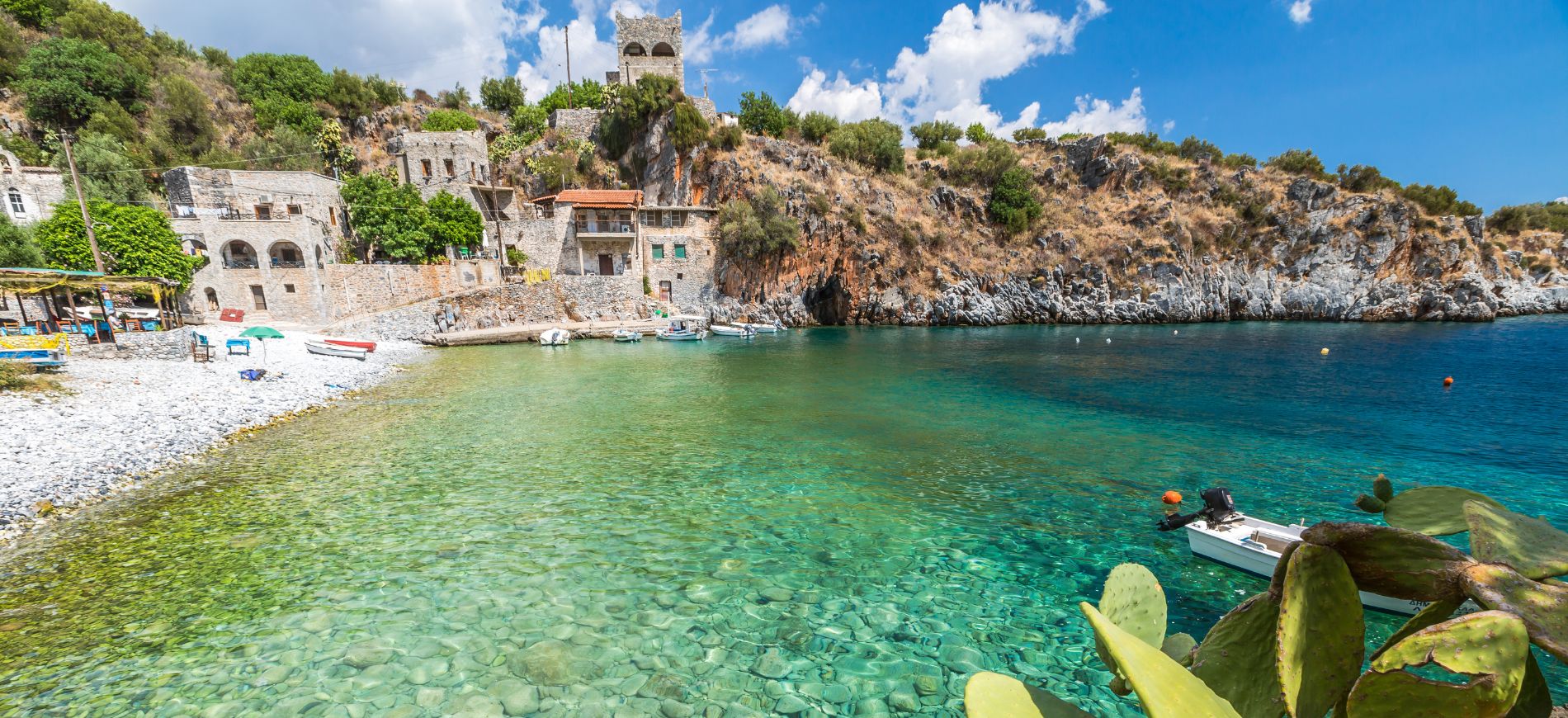
Greece is made up of a mainland and more than two hundred inhabited islands, so the right choice depends heavily on your priorities and budget.
In summary: obtain an AFM tax number, appoint an independent Greek lawyer, open a Greek bank account, sign a preliminary agreement with a deposit of around 10%, then complete before a notary who registers the transfer with the Cadastre. Typically two to four months.
Before you can buy property in Greece you will need an AFM (Arithmos Forologikou Mitroou), the Greek tax registration number issued by the Independent Authority for Public Revenue (AADE). It is required for all financial transactions, including opening a bank account and completing a purchase. Your lawyer can usually arrange this on your behalf through power of attorney, which removes the need to travel to Greece for this step.
Instructing an independent Greek lawyer is strongly recommended and in practice essential. Your lawyer will check title deeds, confirm there are no outstanding debts, mortgages or legal disputes and verify that any building work complies with planning permissions.
That last point matters considerably in Greece, where unauthorised construction has historically been more common than in some other European markets. Use a lawyer entirely independent of the estate agent and the seller. The FCDO publishes a list of English-speaking lawyers in Greece if you need a starting point.
Most transactions require funds to pass through a Greek bank account, so opening one early is sensible. Requirements typically include your AFM, proof of identity and proof of address. The process is comparable to opening a French bank account as a UK resident.
Greek banks also apply anti-money-laundering checks on incoming funds and you will usually need to evidence the source of your deposit. Build this into your timeline early. It is worth knowing how long international bank transfers take before you commit to a completion date.
Once due diligence is complete, buyer and seller typically sign a preliminary agreement and the buyer pays a deposit, often around 10% of the purchase price. This secures the property while the final contract is prepared.
This is the moment your currency risk begins. From here you have a known euro liability and an unknown completion date. It is the natural point to consider fixing your exchange rate with a forward contract.
Completion takes place before a Greek notary public (symvolaiografos), who plays a far more central role than a UK conveyancer. The remaining balance is paid, all applicable taxes are settled and the final deed of sale is signed. The notary then oversees registration with the Hellenic Cadastre (which is the official land registry and mapping system of Greece.), formally transferring ownership.
Our guide to transferring funds for international property purchases covers the payment mechanics in more detail.

Budget an additional 8% to 12% on top of the purchase price. On a €300,000 property that is roughly €24,000 to €36,000 in taxes, legal costs and fees before any furnishing or renovation.
The transfer tax rate is confirmed in PwC's Worldwide Tax Summaries for Greece, which sets out the 3% rate plus municipal surcharge.
VAT of 24% technically applies to properties built or first sold under permits issued after 2006. In practice Greece has suspended that VAT since 2020 and the suspension has been extended again, to 31 December 2026, under Law 5246/2025. Where a developer has opted into the suspension the buyer pays 3.09% transfer tax instead, a difference of nearly 21 percentage points.
It is not automatic. Not every developer elects the suspension and the policy is reviewed periodically. Confirm the VAT position of your specific development with your lawyer before you sign and price both outcomes into your budget if there is any doubt. On a €400,000 new build the gap between the two treatments is more than €80,000 and a currency plan built on the wrong assumption can leave a serious shortfall on completion day.

It is possible for non-residents to obtain a Greek mortgage, though the process is more conservative than in the UK and lending criteria tightened significantly after the Greek financial crisis. Most Greek banks will lend up to around 60% to 70% of a property's value to non-resident buyers, with some going as low as 50%, meaning a deposit of at least 30% is typically required alongside funds to cover taxes and fees.
One important interaction with the Golden Visa: the qualifying investment amount must come from the applicant's own funds. A mortgage cannot be used to fund the minimum threshold itself, so if residency is part of your plan, the €400,000 or €800,000 must be your own equity, with borrowing only possible above that level. Take specific advice from your immigration lawyer before structuring the purchase.
Some buyers instead release equity from a UK property to fund the purchase outright. If you take this route, think carefully about the currency exposure: you will hold a euro-denominated asset while your debt remains in sterling and the two move independently.
ENFIA applies to every owner of Greek property on 1 January of a given year, regardless of nationality or tax residency. There is no separate foreign-owner rate and no foreign-buyer surcharge. It has been levied since 2014 and now sits under Law 5219/2025, Greece's new Property Tax Code.
Under Law 5162/2024, insuring your Greek home reduces your ENFIA by 20% where the taxable value of the property does not exceed €500,000 and by 10% above that. The insurance must cover the previous year and run for a minimum of three months, with the reduction applied proportionally for shorter cover. Details are set out in PwC's Worldwide Tax Summaries for individuals in Greece.
Household insurance is worth having regardless. The fact that it also cuts your annual tax bill makes it close to a free decision.
On acquisition you will file an E9 property declaration. Owners then file an annual E1 income return, with an E2 annex if there is rental income. If you let the property and want to bring the income home, see our guide to sending money from Greece to the UK.

This is where Regency FX becomes an important part of the process and the area buyers most often underestimate until the final stages.
When buying in Greece you will need to convert a significant sum from pounds into euros. For a property costing €300,000 the sterling equivalent varies considerably depending on when and how you exchange. The gap between a good rate and a poor one can amount to thousands of pounds.
The GBP/EUR rate moves constantly in response to interest rate decisions, political developments and broader market sentiment, as our daily market insights and GBP to euro forecasts track. The rate available when you sign your preliminary agreement may be very different months later when you complete.
Consider a €300,000 purchase with a two-month gap between preliminary agreement and completion.
Nothing about the property changed. The price in euros was identical. The buyer simply paid nearly £9,000 more because the rate moved against them across an eight-week window. A forward contract taken at the preliminary agreement stage would have removed that outcome entirely. More on achieving the best euro rate for a property purchase.
In many Greek property transactions the notary or seller will expect the final balance as a bank cheque (trapeziki epitagi) drawn on a Greek bank, rather than a same-day transfer. This is a guaranteed payment: the funds are secured by the bank before the cheque is issued, which is why they are used for high-value transactions. The principle is the same as a UK banker's draft. We explain what a banker's draft is and how it works in full.
The cheque must be prepared in euros for the exact completion amount and available on the day ownership transfers. Any delay in funds arriving, any exchange rate complication, any hold placed by a receiving bank's compliance team can jeopardise the notary appointment.
At Regency FX we work backwards from the notary date, ensuring funds arrive in the correct Greek account with enough time for the bank to issue any required cheque.
There are three realistic ways to move a six-figure sum to Greece and they suit different jobs
In plain terms: if you are sending £500 to a friend, use an app. If you are sending £300,000 against a legal completion deadline, the app model is not built for that job and the bank will charge you heavily for it.
We have written this comparison out at length in banks vs brokers and Wise vs Regency FX: why large transfers need more than an app. If you want to see what your own bank charges, we have broken down HSBC, Barclays, Lloyds, NatWest and Santander individually and explained what the interbank rate actually is.
From around £50,000 upwards. That is the point at which exchange rate movements begin to have a meaningful impact and where the difference between a bank rate and a broker rate stops being academic. See our guide to transferring £50k abroad and our large money transfers service.
All client funds are processed through FCA-authorised partners. Funds are held in ring-fenced safeguarding accounts, kept entirely separate from Regency FX's own business funds. Full detail on the safety of your funds and our regulatory information.
It is worth understanding what safeguarding actually means, because it is different from the FSCS protection you may be used to on a UK bank account.
We work much closer to the real mid-market rate than banks do, with no transfer fees and no hidden margins. Greek and UK banks typically apply margins of 2% to 4% on large international transfers. See our guide to understanding the expenses of transferring money internationally. Your rate is explained clearly before you commit and you can check today's best euro rates at any time.
Every client is assigned a dedicated account manager who oversees the transfer from start to finish. When a notary appointment is booked and a six-figure sum is in motion, a single point of contact who already knows your timeline is worth a great deal. The difference is set out in dedicated account manager vs money transfer apps. You can read what clients say in our testimonials.
Spot contracts exchange currency immediately at the current market rate. Useful for deposits where speed matters.
Forward contracts lock in a rate today for a transfer up to 12 months ahead. This is the tool for the gap between preliminary agreement and notary completion.
Regular payment plans handle ongoing euro costs after completion: utilities, ENFIA, property management fees.

Do I need to be a resident in Greece to buy property there? No. Non-residents can buy property in Greece freely in most areas. You will need an AFM tax number to complete the purchase, but residency is not required for ownership. Certain border and strategically sensitive zones require an additional permit.
How long does the buying process take in Greece? From an accepted offer to completion, usually two to four months, depending on the complexity of due diligence and how quickly documentation can be gathered. New builds and Golden Visa applications extend this.
How much does it cost to buy property in Greece? Budget 8% to 12% on top of the purchase price. On a €300,000 property that is roughly €24,000 to €36,000, covering the 3.09% transfer tax, notary fees of 1% to 1.5%, legal fees of 1% to 2%, registration of around 0.5% and agent commission of around 2%.
Do I pay 24% VAT on a new-build property in Greece? Usually not. The 24% VAT on new builds is suspended until 31 December 2026 where the developer has opted in, in which case you pay the 3.09% transfer tax instead. It is not automatic, so confirm the position for your specific development with your lawyer before signing.
Do I need a Greek bank account to buy property? In practice, yes. A Greek account is generally required to complete the purchase and to manage ongoing costs such as ENFIA, utilities and community fees. You will need your AFM to open one.
What happens if the exchange rate moves between signing the preliminary agreement and completion? This is a genuine risk. If sterling weakens against the euro during that window, the cost of your purchase in pounds rises and on a €300,000 property a four-cent move is worth close to £9,000. A forward contract allows you to lock in your rate at the preliminary agreement stage.
Is it safe to buy property in Greece as a foreign national? Yes, provided the right precautions are taken. Instructing an independent Greek lawyer to carry out thorough due diligence, particularly around planning permissions and title history, is essential. Unauthorised construction has historically been more common in Greece than in some other European markets, which makes independent legal checks non-negotiable.
What is the minimum investment for the Greece Golden Visa in 2026? €800,000 in Attica, Thessaloniki, Mykonos, Santorini and islands with over 3,100 residents; €400,000 in all other regions; and a narrow €250,000 route for commercial-to-residential conversions and listed buildings. The higher two tiers require a single property of at least 120 square metres.
How can I reduce my annual ENFIA bill in Greece? Insured residences receive a 20% ENFIA reduction where taxable value does not exceed €500,000 and 10% above that. Cover must apply to the previous year and last at least three months.
How much could I save by using Regency FX instead of my bank? Banks typically apply margins of between 2% and 4% on large international transfers. On a €300,000 purchase, a 3% margin costs approximately £7,500 more than necessary. Regency FX works much closer to the real mid-market rate with no transfer fees.
What is the safest way to transfer a large sum to Greece? Use a provider whose client funds are held in ring-fenced safeguarding accounts at FCA-authorised institutions, separate from the firm's own money. Verify the authorisation yourself on the FCA Financial Services Register, never act on payment details changed by email and allow time for compliance checks at the receiving Greek bank. See transferring large amounts of currency.
Can I use the same approach if I'm buying in Spain instead? The currency principles are similar, though the legal process and tax rates differ. See our companion guide to buying a property in Spain.
Buying a home in Greece is one of the most significant financial decisions many people make. The exchange rate you achieve, the timing of your transfers and the support available all have a direct bearing on the final cost.
Regency FX is the right partner whenever a transfer is large enough that a shift in the exchange rate, a timing mistake or a missed deadline would genuinely matter. For property buyers, that is almost always the case.
Our dedicated account managers have supported buyers through every stage of the Greek property purchase, from the preliminary agreement through to completion at the notary. They understand the pressures of legal deadlines and the importance of funds arriving safely and on time. Find out more about us, see what we offer, or get in touch.
© RegencyFX. Unauthorised copying or re-wording of this blog content is prohibited. Any unauthorised copying or re-wording will constitute an infringement of copyright. The copyright of this content is owned by Regency FX Ltd.


